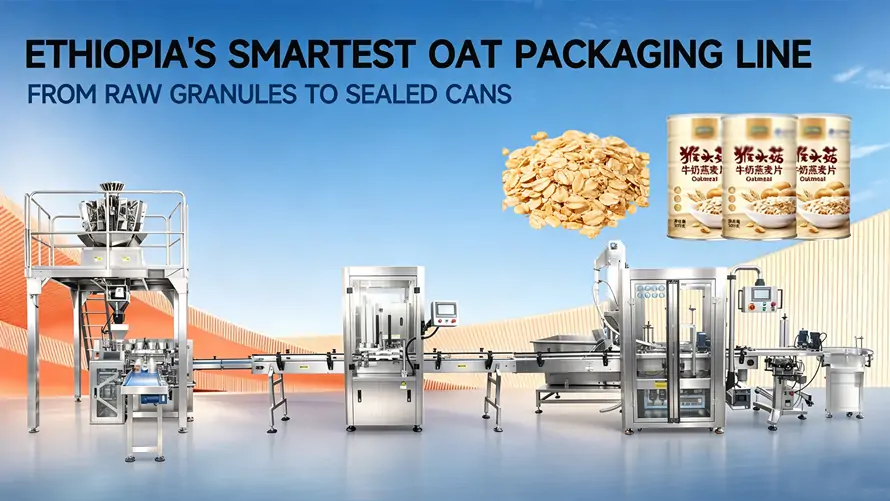
Custom RIFU dual turntable aluminum can packaging line for Ethiopian oat granule production. Integrated multihead weigher filling, can sealing, cap pressing & UV laser coding, complete pre-shipment factory running test.
The Challenge: From Manual Bottleneck to Automated Precision
An Ethiopian food manufacturer specializing in canned oat flakes, cereals, and dry granular snacks approached us with a familiar problem: their semi-manual packaging line had become a growth bottleneck. With 6 to 8 workers struggling to maintain output, inconsistent weighing accuracy, and material waste eating into margins, the operation was crying out for a full-scale automation upgrade.Their requirements were precise — aluminum cans (100mm diameter × 110mm height), a target fill weight of 500g per can, and a throughput of 30-40 cans per minute. But the real test was the environment: Ethiopia's tropical climate, where high humidity and temperature swings pose a genuine threat to dry food shelf life.They needed more than machines. They needed a turnkey partner who understood the end-to-end picture.
Our Solution: The Dual Turntable Rotary Packaging Line
We designed and delivered a fully integrated, compact production line that takes raw oat granules from hopper to finished, coded, and capped cans — with just one operator supervising the entire process.
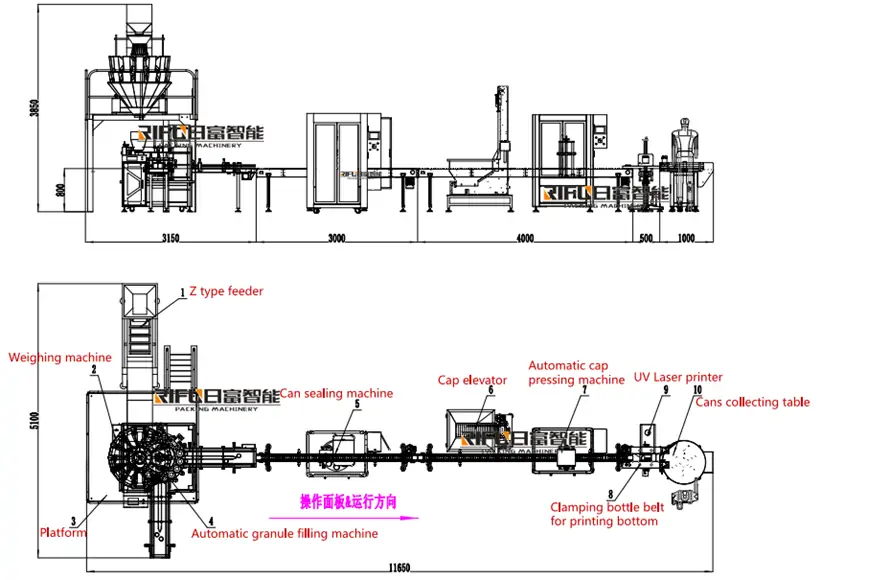
Line Configuration at a Glance
Five Problems, One Line: What This Turnkey Solution Solved
1. Labor Dependence → Single-Operator Supervision
The original semi-automatic workflow demanded 6 to 8 workers across feeding, weighing, filling, sealing, capping, and coding stations. The new line consolidates all functions into one continuous automated sequence. Result: one operator for supervision and routine maintenance, with direct and immediate labor cost reduction.
2. Weighing Inconsistency → Precision Dosing
Manual weighing introduced daily variances that translated directly into product giveaway or underfill rejections. The 14-head multihead weigher — equipped with Mettler Toledo sensors and running at a verified ±0.5g tolerance — eliminated both overfill waste and underfill quality risks. Every can leaves the filler with consistent, verifiable weight.
3. Climate-Driven Spoilage → Airtight Seam Integrity
Ethiopia's high-humidity tropical conditions create a hostile storage environment for dry oat products. The automatic can seaming machine and press capping machine delivers a reliable hermetic seal on every can, protecting contents from moisture ingress. The package holds its integrity from factory floor to consumer pantry.
4. Wasted Floor Space → Compact Linear Integration
Individual standalone machines would have demanded wasteful spacing and manual transfer between stations. The integrated 10.85m layout — with dual turntable design, cap elevator side-feeding, and inline bottle clamping — packs full functionality into a footprint optimized for constrained workshops.
5. No Traceability → Full Batch Visibility
Manual ink stamping was inconsistent, smudge-prone, and offered no digital record. The UV laser printer etches permanent, scannable production dates, batch numbers, and traceability codes directly onto each can bottom — enabling end-to-end batch tracking for quality audits, recalls, and retail compliance.
Why This Matters for Dry Food Manufacturers
This project illustrates a pattern we see across emerging-market food producers: the gap between growing demand and semi-manual packaging is where margins evaporate. The decision to automate is not just about speed — it is about weight consistency, seal integrity, labor efficiency, and brand credibility at the retail shelf.
A turnkey line that arrives pre-tested, runs on local power standards, and operates with English-language controls dramatically reduces the commissioning risk for overseas buyers.
Looking for a customized dry food packaging solution? [Contact our engineering team] to discuss your product, can size, and output requirements — we design and factory-test every line before shipment.
