00431
A liquid filling machine measures a volume of product and delivers it into a container. How it measures is the decision that matters: a piston draws product into a cylinder and pushes it out, a gravity filler lets product fall through a timed valve, a pump moves it through a nozzle, and a weighing filler stops the flow when the scale reaches the target weight. The choice follows the viscosity of the product and the volume per container, not the container shape.
This page lists 44 machines. They fall into six groups by metering principle, and the group is decided before the model is.
| What you are filling | Metering principle | Machines |
| Water-thin liquids — juice, vinegar, alcohol, eye drops, floral water | Gravity through a timed valve, or a magnetic pump where the product must not touch a rotor | Gravity flow juice and beverage filler Magnetic pump filler for vinegar and alcohol |
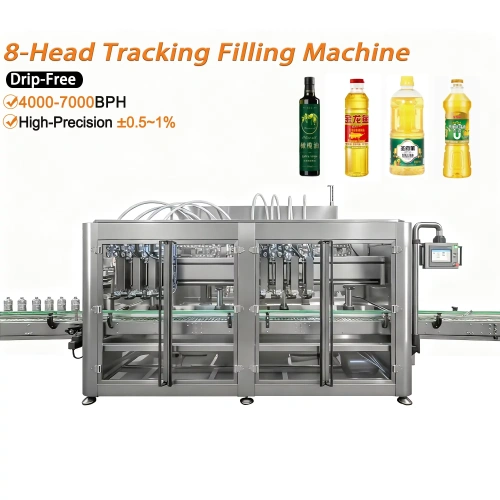
| Oils and thin emulsions — edible oil, lubricating oil, cosmetic water | Piston, because the volume is held in a cylinder and does not depend on flow time | Rapeseed oil piston filler Eight-head tracking filler for edible oil |
| Sauces and pastes — tomato paste, shampoo, hand wash, honey, thick cream | Piston with a wide bore, or a rotor pump where the product is too stiff to draw into a cylinder | Tomato paste and jam filler Rotor pump filler for thick sauce Horizontal paste piston filler |
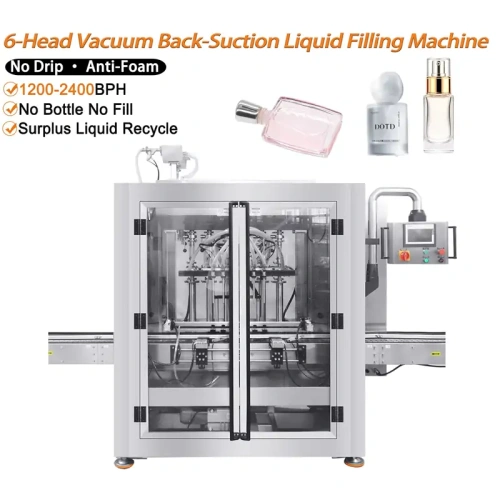
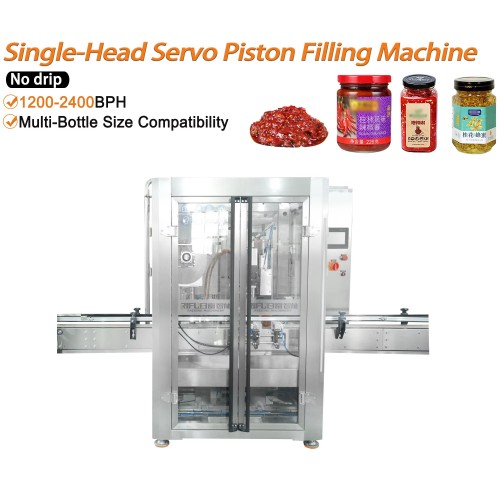
| Small bottles and vials — 3 to 200 ml of oral liquid, reagent, perfume, cosmetic | Servo piston for repeatability, peristaltic pump where the product is explosive or must stay sterile, vacuum back-suction to stop drips | Single-head servo piston filler Explosion-proof peristaltic filler Vacuum back-suction filler |
| Large volumes — 1 to 25 L pails, drums and barrels | Weighing, because at that volume a scale is more reliable than a cylinder | Weighing filler for 5–25 L barrels Weighing filler for 1–10 L oil |
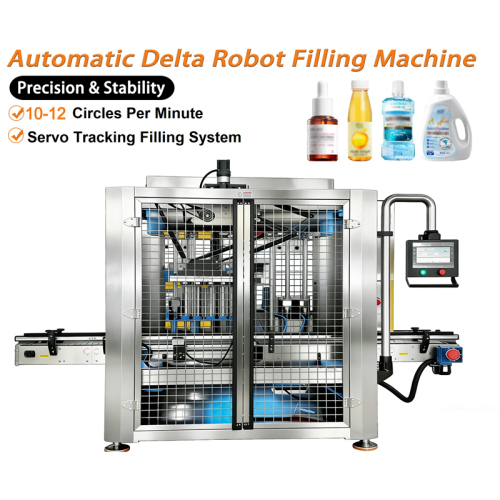
| Odd shapes or unstable containers | Robot or tracking head that follows the container instead of moving it in a straight line | Delta robot six-head filler Mobile tracking filler for 1–5 L |
Fill range, head count and accuracy are the three figures to compare. Where a page gives a range as customizable, it is confirmed per order rather than fixed by the standard build.
| Machine | Heads and fill range | Accuracy and power |
| Single-head servo piston filler | 1 head; 30–500 ml, customizable | ±0.5–1%; 220/380 V |
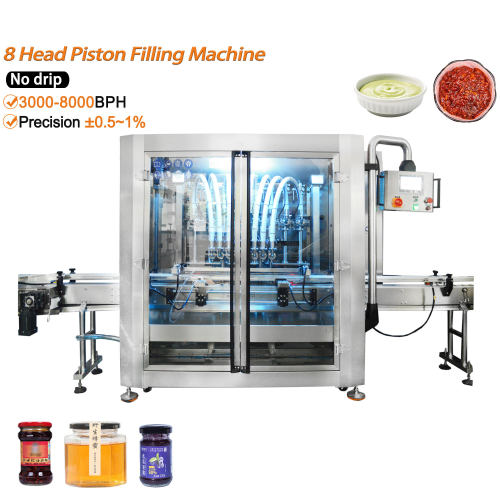
| Eight-head high-precision piston filler | 8 heads; 100–1000 ml, customizable | ±0.5–1%; 220/380 V |
| Twelve-head small-volume piston filler | 12 heads; 2–100 ml, customizable | ±1%; 2 kW |
| Horizontal paste piston filler | 10–5000 ml, customizable | ±1% |
| Gravity flow juice and beverage filler | 100–5000 ml | ±1% |
| Magnetic pump filler for vinegar and alcohol | 100–5000 ml | ±1% |
| Explosion-proof peristaltic filler | 2 heads; 10–150 ml | ±0.5–1%; 220/380 V |
| Rotor pump filler for thick sauce | 2 heads; 50–1000 ml, customizable | ±1%; 220/380 V; 2000 × 1450 × 2000 mm |
| Vacuum back-suction filler | 6 heads; 10–150 ml, customizable | 220/380 V; 2000 × 900 × 2100 mm |
| Delta robot six-head filler | 6 heads; 5–500 ml, customizable | ±0.5–1%; 2200 × 1600 × 2350 mm |
| Weighing filler for 5–25 L barrels | 5–25 L | ±1%; 2.4 kW, 220 V |
| Weighing filler for 1–10 L oil | 1–10 L | ±1%; 2.4 kW, 220 V |
Accuracy is quoted as a percentage of the fill volume, so the same machine is tighter on small fills and looser on large ones. At ±1%, a 100 ml fill allows ±1 ml and a 1000 ml fill allows ±10 ml. On a 5 L barrel the same ±1% allows ±50 ml, which is why large volumes are weighed rather than metered by volume. Compare the figure with the container you actually sell.
Two problems sit outside the metering principle and are solved by options rather than by choosing a different machine type. Dripping after the nozzle lifts is handled by vacuum back-suction, which pulls the last drop back into the line. Corrosive or flammable products need the wetted parts and the electricals specified for them: this range includes anti-corrosive and explosion-proof builds, and the right one is decided by the product, not by the container.
Where the container is small and the line has to be compact, filling and capping are built on one base rather than two machines. This range includes a cosmetic water and emulsion filler-capper, a small-bottle filler-capper for potions and essences, an oral liquid filler with crimping and a spout-pouch filler for jelly and beverages. The trade-off is that the two stations are set for one container family; changing to a different bottle usually means changing the change parts on both stations.
To quote accurately we need: the product name and how it flows — water-thin like vinegar, oily like cooking oil, thick like ketchup, or a paste that holds its shape; the fill volume per container; the container type and its neck diameter; the output you need per hour; the supply voltage on site; and whether the product is corrosive, flammable or food-grade, because that decides the wetted parts and the electrical build.
Follow the viscosity. Water-thin products that flow on their own suit gravity or a magnetic pump; oils and emulsions suit a piston; sauces and pastes need a wide-bore piston or a rotor pump; large volumes are weighed. Fill volume then narrows the model, because a piston is built around a cylinder size.
The published figures in this range are ±0.5–1% on servo and peristaltic models and ±1% on most piston, gravity and weighing models. Because it is a percentage of the fill, ±1% on a 100 ml bottle is ±1 ml and on a 5 L barrel is ±50 ml. Confirming the figure against your own container is part of the quotation.
Yes, with the right build. This range includes anti-corrosive machines for products that attack standard stainless steel, and explosion-proof machines for flammable liquids — the peristaltic filler and the anti-explosion liquid filler are both in that group. Tell us the product when you enquire, because it changes the wetted parts and the electricals.
Only within the published range. A piston covers a cylinder stroke, so a single machine is specified for one band — for example 100–1000 ml or 10–5000 ml — and the band is confirmed at order. Crossing from small bottles to barrels usually means a different machine, which is why this range separates weighing fillers for 5–25 L from the piston models.
Not necessarily. For small bottles and vials the filling and capping stations are offered on one base, and this range includes filler-cappers for cosmetic liquids, potions, oral liquids and spout pouches. For larger containers and for lines that also label or carton, the stations are separate machines.
Vacuum back-suction: when the nozzle lifts, the last drop is pulled back into the line instead of falling on the container. It is a standard build on the vacuum back-suction model and an option on the pump and piston models. It matters most on thin products and on small fills, where one stray drop lands on the bottle.
The product and how it flows, the fill volume, the container and neck diameter, the output per hour, the supply voltage, and whether the product is corrosive, flammable or food-grade. With those six answers we can name the metering principle and a model rather than a range.