00431
An automatic capping machine tightens, presses or seals a closure onto a filled container without manual handling. RIFU builds cappers for screw caps, press-on caps, vacuum lug caps, pump and trigger sprayers, and tin can seaming — all able to run on the same line as your filler and labeling machine.
Choosing a capper comes down to three things: the closure type, the container material, and your target speed. The table below maps each closure to the RIFU machine built for it.
| Your closure | Typical container | Recommended RIFU machine |
|---|---|---|
| Screw cap | plastic or glass bottle, jar | Automatic Servo Bottle & Jar Capping Machine |
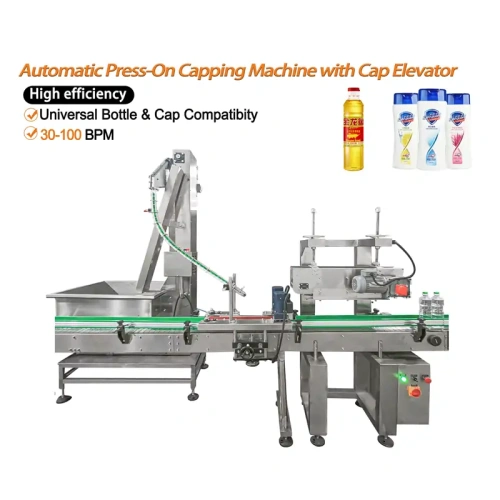
| Press-on / snap cap | oil, shampoo and beverage bottles | Automatic Press-On Capping Machine with Cap Elevator |
| Metal twist-off lug cap | glass jars for jam and hot sauce | Automatic Glass Bottles Fruit Jam Jar Metal Twist-off Caps Vacuum Steam Capping Machine for Hot Sauce |
| Tin can or paper can | food and dry-goods cans | Automatic Can Seaming Machine |
| Barrel, bucket or drum | large industrial containers | Automatic barrel bucket drum servo capping machine |
| Pharmaceutical syrup bottle | glass syrup bottles | Automatic servo motor pharmaceutical vitamin syrup bottle capping machine |
| Irregular or mixed containers | vision-guided positioning | Automatic Delta Robot Capping Machine |
| High-volume universal | mixed bottles on one line | High-Speed Automatic Bottle Capping Machine |
If your closure is not listed, send us a sample cap and bottle — we confirm the capping head and torque setting with a material test before quoting.
Cap damage comes from torque that is too high or a capping head that grips too hard. RIFU uses adjustable torque control and soft-touch capping heads, and for cosmetic-grade caps we fit servo-driven capping heads so torque is set digitally rather than mechanically. The result is a leak-proof seal with no scratched or deformed caps.
Yes. RIFU capping machines can be configured to run more than one bottle size on the same machine — different bottle diameters and heights. When you enquire, send us the full range of bottles and caps you need to run and we will confirm which of them one machine can cover.
A capper is normally the station directly after filling. RIFU cappers run standalone with a conveyor for semi-automatic production, or integrate with an automatic filling machine, a cap elevator, a labeling machine and a case packer to form a fully automatic line.
Machine specification summary — stainless steel construction, components from Siemens, Schneider and Airtac, CE certified, and voltage configurable for your local supply. RIFU operates a 20,000+ square meter facility in Guangzhou with over 200 industry experts, and has deployed 5,000+ customized production lines for food, cosmetic and chemical industries.
Tell us three things — your closure type, your container size, and your target output per minute — and we will recommend the model and confirm it with a material test. Request a quote or send us a sample cap and bottle.
A: Our automatic capping machines are highly versatile and engineered to handle various cap designs, including screw caps, pump caps, trigger sprayers, flip-top lids, and press-on caps. They are widely used for containers in the food, cosmetic, pharmaceutical, and chemical industries.
A: We utilize adjustable torque control systems and soft-touch capping heads (usually made of wear-resistant silicone) to ensure a secure, leak-proof seal without deforming or scratching the cap surface. For delicate cosmetic caps, we can also integrate servo-driven capping heads for ultra-precise torque management.
A: Yes. RIFU capping machines can be configured to run more than one bottle and cap size on the same machine. Send us the dimensions you need to cover and we will confirm which of them one machine can handle.
A: The High-Speed Automatic Bottle Capping Machine runs at 60 to 120 bottles per minute. Actual output depends on the cap type, bottle shape and cap feeding method, so we recommend a material test before finalising the configuration.
A: Press-on capping pushes a snap cap onto the container and suits oil, shampoo and beverage bottles. Screw capping applies controlled torque to tighten a threaded cap and suits beverages and cosmetics. Vacuum capping creates negative pressure inside a glass jar to seal metal twist-off lug caps, and is used for jam, hot sauce and other hot-filled products.
A: Yes. RIFU supplies both a fully automatic can seaming machine for food and paper cans, and a semi-automatic circular tin can seamer that supports vacuum and nitrogen flushing for oxygen-sensitive products.
A: RIFU capping machines are CE certified and use components from Siemens, Schneider and Airtac. Voltage is configurable to match local industrial supply requirements.
A: Yes. RIFU capping machines run standalone with a conveyor for semi-automatic production, or integrate with a filler, cap elevator, labeling machine and case packer to form a fully automatic filling and capping line.